Unknown Facts About Proctor’s Ledge in Salem, MA.
Uncovering Salem’s history. When people think of the infamous 1692 Salem Witch Trials, popular culture usually conjures images of dramatic trials, strict Puritan judges, and mass executions atop a sweeping, windy hill. For centuries, the public and historians alike assumed that the tragic hangings took place at the summit of Gallows Hill in Salem, Massachusetts.
Yet, conversely, modern historical research completely changed our understanding of this dark chapter. A quiet residential neighborhood hides Proctor’s Ledge in plain sight—the verified, actual site where authorities executed 19 innocent people.
Whether you plan a heritage trip or feel a deep fascination for American history, these essential facts about Proctor’s Ledge will guide your exploration.
1. It Was Finally Confirmed in 2016
For over 300 years, the exact location of the executions remained a mystery because the original court records from 1692 never explicitly noted where the hangings took place. That changed in January 2016, when a team of researchers known as the Gallows Hill Project (including prominent local historians and scientists like Emerson Baker and Benjamin Ray) definitively proved that Proctor’s Ledge was the true execution site.
2. Why Not the Top of Gallows Hill?
Generations believed the hangings happened at the peak of Gallows Hill. However, researchers used geographical analysis and historical context to debunk this:
- The Carts Couldn’t Make It: The slope to the summit of Gallows Hill was too steep for the heavy carts carrying the condemned.
- Line of Sight: Gallows Hill is blocked from view by nearby terrain. Executions in the 17th century were meant to be public spectacles visible to the surrounding community; Proctor’s Ledge, sitting lower at the base of the hill, was completely visible from surrounding roads like Boston Street.
3. Eyewitness Accounts Proved the Location
The research team relied heavily on 17th-century eyewitness testimonies. For instance, an accused woman named Rebecca Eames testified that on August 19, 1692, she and her guards traveled along Boston Road and watched the executions unfold from “the house below the hill”. Modern viewshed analyses proved that a house in that exact spot had a direct, unobstructed line of sight to Proctor’s Ledge.
4. An Early Historian Got It Right a Century Ago
While the 2016 confirmation made national headlines, local historian Sidney Perley actually figured it out back in 1921. Perley published detailed property maps and historical evidence pointing directly to Proctor’s Ledge. Thanks to his work, the City of Salem even purchased a small parcel of the land in 1936, dubbing it “Witch Memorial Land”. Unfortunately, time eroded that knowledge, officials built no marker, and people largely forgot the land for decades.
5. No Mass Graves Exist There
Core samples and geological testing of Proctor’s Ledge revealed that the rocky cliffside has very little soil—in most places, less than three feet deep. This matches historical oral traditions and accounts indicating that there was no room to properly bury the victims on-site. Instead, under the cover of darkness, grieving families (such as Benjamin Nurse) secretly retrieved the bodies of their loved ones to give them proper burials in family plots.
6. Where is it Located Today?
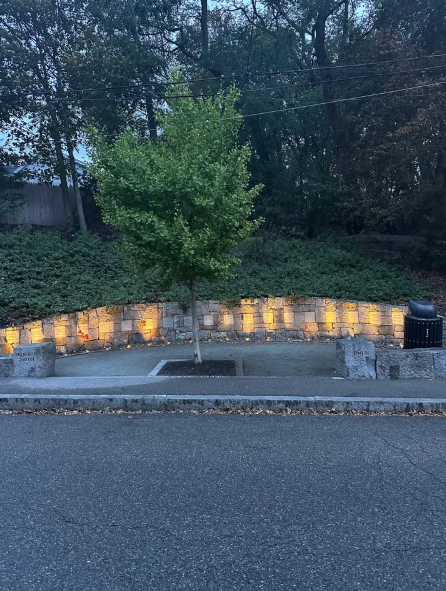
Proctor Street and Pope Street tuck Proctor’s Ledge into a quiet residential area directly behind a modern commercial strip on Boston Street (near a local Walgreens). Despite being right in the middle of town, it feels remarkably quiet and removed from the heavily commercialized witchcraft attractions downtown.
7. The Memorial Was Dedicated in 2017
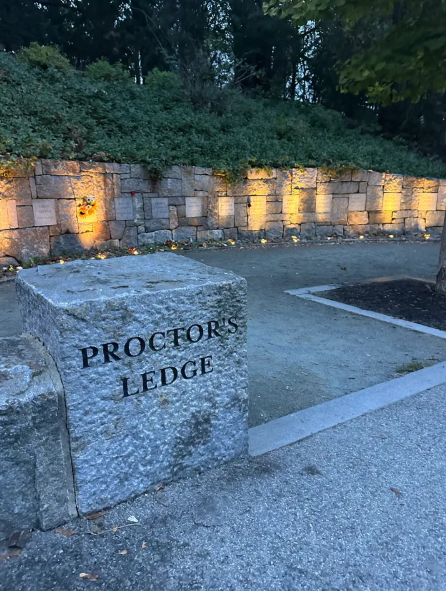
To mark the 325th anniversary of the trials accordingly, the City of Salem constructed a solemn, respectful memorial at the base of the ledge uncovering Salem’s history. Dedicated on July 19, 2017, the memorial features a semicircular stonewall embedded with 19 individual granite stones—one for each person executed by hanging during the hysteria.
The names engraved on the memorial stones include:
- Bridget Bishop
- Sarah Good
- Elizabeth Howe
- Susannah Martin
- Rebecca Nurse
- Sarah Wildes
- George Burroughs
- Martha Carrier
- John Willard
- George Jacobs, Sr.
- John Proctor
- Alice Parker
- Mary Parker
- Ann Pudeator
- Wilmot Redd
- Margaret Scott
- Samuel Wardwell
- Martha Corey
- Mary Easty(Note: Giles Corey was also killed during this period, but he died via pressing at the jail, not hanging at the execution site).
Plan Your Visit
If you visit Proctor’s Ledge today, you won’t find flashing lights or souvenir shops. It is a quiet place designed for quiet reflection. Street parking directly around Pope and Proctor Streets is limited. Visitors typically park nearby at Gallows Hill Park and take a short, reflective walk down to the site. It is an essential stop for anyone wanting to honor the true history and human cost of the 1692 trials. Therefore, uncovering Salem’s history has never been so interesting. Plan your visit today.