Walk the Chesapeake Story That Built a State.
The colony of Maryland began as a bold refuge on the Chesapeake. Lord Baltimore wanted Catholics and Protestants to share one province. Travelers still walk those same shores today. Indeed, the colony of Maryland left markers, houses, and harbors you can visit this year. Book a trip and stand where the story started.
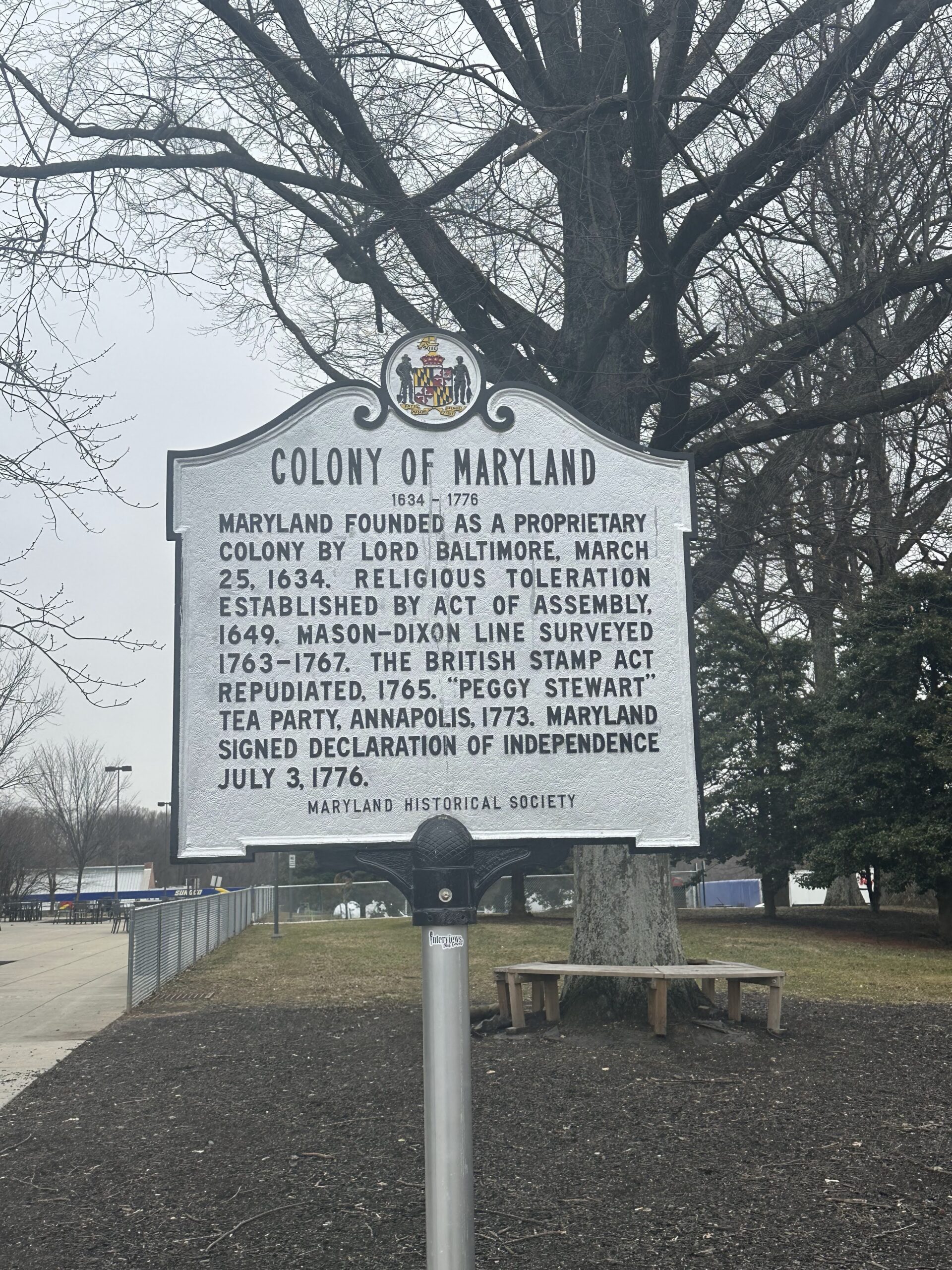
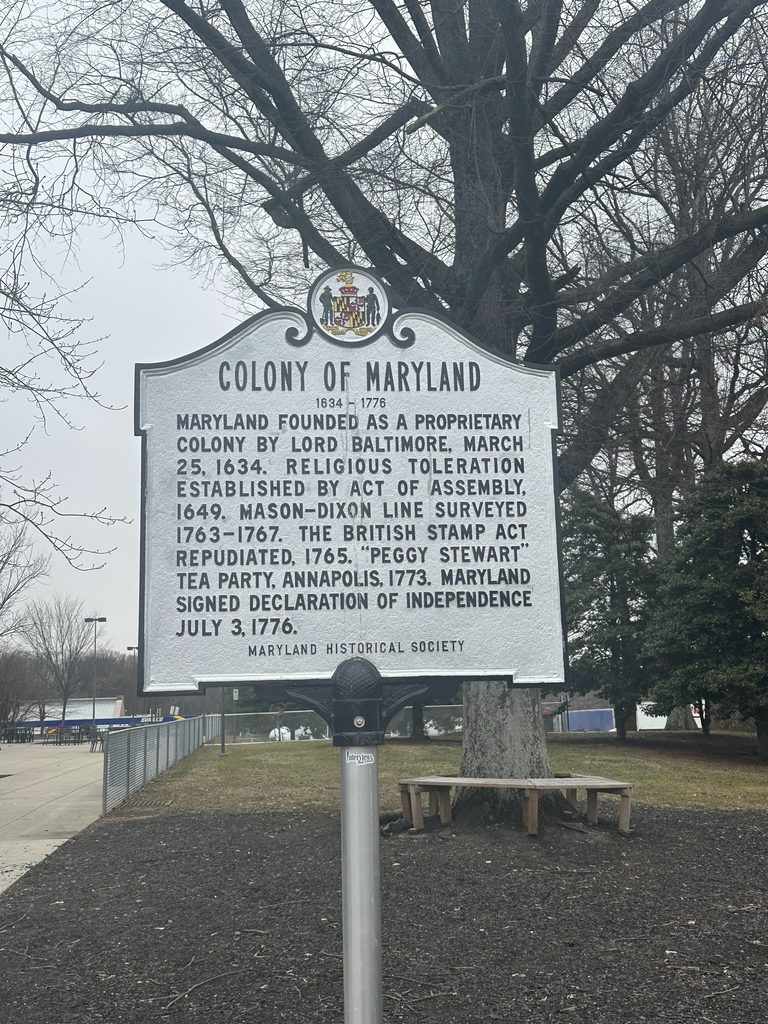
A white Maryland Historical Society marker still tells the outline in plain letters. It lists the founding date, the toleration law, the Mason-Dixon survey, and the Peggy Stewart tea party. Furthermore, it names the colony of Maryland and the years 1634 to 1776. That short text is a perfect map for a weekend.
Why the Colony of Maryland Still Draws Travelers
People come for brick streets, working harbors, and a clear origin story. However, they stay for the details. You can trace a proprietary colony from a river landing to a capital that still governs. Consequently, one short drive links St. Mary’s City, Annapolis, and Baltimore.
Plan three bases and you cover the whole arc. First, sleep near St. Mary’s City for the founding years. Next, shift to Annapolis for revolution and tea. Finally, add Baltimore for the port that outgrew the old capital. Indeed, each stop rewards an early start and a slow afternoon.
How the Colony of Maryland Began in 1634
George Calvert, the first Lord Baltimore, asked King Charles I for a grant. He wanted a province where English Catholics could worship in peace. However, he died in 1632 before the charter was sealed. Consequently, his son Cecil Calvert inherited both the title and the project.
Cecil never sailed with the first ships. Instead, he sent his brother Leonard Calvert as governor. On November 22, 1633, the Ark and the Dove left Cowes on the Isle of Wight. Furthermore, about 140 to 200 settlers shared the two vessels. They carried tools, livestock, and a risky political plan.
The Landing That Started the Colony of Maryland
The ships reached the Potomac in March 1634. On March 25, Leonard Calvert and his company landed at St. Clement’s Island. They raised a cross and held the first Mass in the new province. Indeed, Maryland still marks March 25 as a founding day.
The island was too small for a town. Therefore, the leaders looked for a sheltered site with fresh water and fields. They met the Yaocomico people, who farmed and traded along the St. Mary’s River. Consequently, the two groups struck a bargain for a village site.
Settlers named the place St. Mary’s City. Furthermore, it became the first capital of the colony of Maryland. Wooden houses, a fort, and a chapel rose within months. Today the outdoor museum rebuilds that town so you can walk the grid.
Book a morning at Historic St. Mary’s City before the crowds build. Guides explain the chapel, the print shop, and the reconstructed ship Maryland Dove. Moreover, the Freedom of Conscience monument stands near the old capital grounds. You leave with a clearer sense of 1634 than any textbook gives.
A Proprietary Colony With a Family at the Helm
Maryland was not a royal colony at the start. The king granted Cecil Calvert wide powers as Lord Proprietary. He could appoint governors, grant land, and collect quitrents. However, freemen still expected a voice in local laws.
Land drew the ambitious. Headright grants rewarded anyone who paid a passage. Furthermore, tobacco became the cash crop that paid debts in London. Plantations spread along creeks because ships could load hogsheads at private wharves. Indeed, the water was the road.
The 1649 Act and the Colony of Maryland’s Boldest Law
Religious peace was never automatic. Catholics founded the province, but Protestants soon outnumbered them. Ingle’s Rebellion in the 1640s showed how fast faith and politics could collide. Therefore, Cecil Calvert pushed for a written guarantee.
What the Act Meant in the Colony of Maryland
On April 21, 1649, the assembly at St. Mary’s City passed An Act Concerning Religion. The law said no person professing belief in Jesus Christ should be troubled for that faith. Furthermore, it used the phrase “free exercise,” words Americans still know. It also banned sectarian insults in public speech.
The protection had hard limits. It covered Trinitarian Christians, not everyone in the province. Moreover, the act threatened severe punishment for blasphemy. Even so, it was among the first written toleration laws in the English-speaking world. Consequently, Maryland still claims that legacy on monuments and markers.
Later decades tested the promise. Puritan rule in the 1650s overturned the act for a time. The Glorious Revolution of 1689 ended Catholic political control in the province. Furthermore, the Church of England became the established church in 1702. Yet the earlier experiment still shapes how Maryland tells its story.
Stand at the Freedom of Conscience monument and read the dates slowly. Then walk to the reconstructed brick chapel, begun in the 1660s. Indeed, the colony of Maryland put belief into buildings as well as statutes. A ranger can point you to the archaeology under your feet.
Life Along the Chesapeake
Daily work followed the water. Families planted tobacco, corn, and orchards on neck lands between creeks. Furthermore, they fished, hunted, and traded with neighboring colonies. A planter’s year ran from seedbed to hogshead to the London ship.
Towns stayed small for decades. St. Mary’s City never became a dense port like Boston. However, ferries, ordinaries, and county courts stitched the province together. Consequently, travelers today should expect scattered sites, not one walled old town.
From St. Mary’s City to Annapolis
In 1695 the capital moved to Annapolis, then called Anne Arundel Town. Sir Francis Nicholson laid out circles and radiating streets on the Severn River. Furthermore, the new site faced the bay and a growing planter elite. The colony of Maryland suddenly had a stylish little capital.
Visit the State House, begun in the 1770s, and you stand in a working government building. It is the oldest state capitol still in continuous legislative use. Moreover, the Old Treasury and waterfront inns keep the colonial scale. Book a historic-district walk before dinner on Ego Alley.
Conflict, a Border Line, and a Tea Ship
Imperial taxes reached Maryland with the rest of the colonies. The marker on many roadside stops notes that Maryland repudiated the British Stamp Act in 1765. Local leaders argued the tax violated their rights as English subjects. Consequently, protest moved from pamphlets to street action.
The Mason-Dixon Years and the Colony of Maryland’s Edge
Maryland and Pennsylvania argued for decades over their shared border. The dispute mixed proprietary claims, settler violence, and map errors. Therefore, Charles Mason and Jeremiah Dixon surveyed the line from 1763 to 1767. Their work fixed a boundary people still name today.
You can chase surviving stones on quiet back roads in northern Maryland. Furthermore, small museums explain the instruments and the politics. The line later gained a darker fame as a symbol in the slavery debate. Indeed, a day trip north from Baltimore makes that story concrete.
The Peggy Stewart and the Road to Independence
On October 19, 1773, the brig Peggy Stewart reached Annapolis with a taxed tea cargo. Owner Anthony Stewart paid the duty to save his ship from seizure. However, angry residents demanded a stronger answer. Consequently, Stewart and others burned the vessel and its tea in the harbor.
The Peggy Stewart tea party was Maryland’s sharpest reply to the Tea Act. Furthermore, it showed Annapolis could match northern ports in defiance. A waterfront marker and dockside views still frame the event. Book a harbor cruise and picture the smoke against the State House dome area.
Maryland hesitated longer than some colonies on a full break. Leaders feared war, lost trade, and a weak new government. However, on June 28, 1776, the convention finally instructed its delegates to vote for independence. Charles Carroll of Carrollton drafted related language on July 3.
On July 6, 1776, Maryland issued its own declaration of independence. Congress had already approved the national Declaration on July 4. Furthermore, four Maryland men later signed the engrossed copy in August. They were Charles Carroll of Carrollton, Samuel Chase, William Paca, and Thomas Stone.
Some older markers compress that sequence into a single July 3 line. The simpler date points to Carroll’s draft and the rush of that week. Indeed, the colony of Maryland ended in those summer days of 1776. A state took its place before the year closed.
People You Meet in the Records
Charles Carroll of Carrollton was the only Catholic signer of the Declaration. He risked a large fortune and signed with his full name so no one could mistake him. Moreover, his Annapolis house and Baltimore County lands reward a paired visit. Guides connect the man to the earlier toleration fight.
William Paca, Samuel Chase, and Thomas Stone round out the signer set. Annapolis is rare because houses linked to all four still stand. Consequently, one walking tour covers a whole delegation. Book timed tickets in peak season so you are not shut out.
What to See on a Colony of Maryland Trip
Build the visit around places, not just dates. Historic St. Mary’s City covers the 1634 landing and the first capital. Furthermore, St. Clement’s Island Museum sits across the water from the first landing site. A small boat or a shoreline view completes the founding day.
Annapolis carries the late colonial and revolutionary chapters. Walk the State House, the waterfront, and the signer houses. Moreover, the William Paca House and Garden show how wealth looked in the 1760s. Eat blue crabs after the tour and you have the local ritual.
How to Plan the Booking
Give the founding sites two nights, not a rushed afternoon. St. Mary’s City opens seasonally, so check hours before you lock rooms. Furthermore, spring and fall bring milder light for photos of markers and brick. Summer adds crabs, boats, and thicker crowds.
Stay in Annapolis for the revolutionary half of the story. Historic inns put you inside the street plan Nicholson drew. Moreover, a car still helps for St. Clement’s Island and the northern stones. Trains reach Baltimore easily if you want a car-free city day.
Why the Story Still Matters
The colony of Maryland tried a written religious peace earlier than its neighbors. The attempt was narrow, and later laws walked much of it back. However, the phrase “free exercise” escaped the statute and entered American habit. You can stand at the monument and weigh both facts.
The same province burned tea, fixed a famous border, and joined the break with Britain. Four signers from one small capital left houses you can still enter. Consequently, the colony of Maryland is not an abstract chapter. It is a set of streets, docks, and stones within a day’s drive of one another.
Furthermore, the Chesapeake setting makes the politics physical. You see why ships mattered, why creeks shaped plantations, and why a capital moved. Indeed, the landscape explains the documents. That is the gift of going in person.
Book the Trip and Walk the Years
Start with the marker text and then go deeper on site. March 25, 1634, the 1649 act, the 1760s line, and the 1773 tea ship all have addresses. Moreover, July 1776 closes the colonial chapter in Annapolis records and signer homes. The colony of Maryland ends where a state begins.
Reserve rooms near St. Mary’s City and Annapolis before spring weekends fill. Add one Eastern Shore night if you want quieter docks. Furthermore, leave time for a harbor hour with no agenda. You will remember the water as clearly as the dates.
Indeed, the best reading happens on your feet. Stand on St. Clement’s shore, then on the Annapolis dock where protest turned into flame. Consequently, the colony of Maryland becomes a route, not a paragraph. Book the trip, follow the markers, and let the Chesapeake finish the story.